
Selling a home is exciting, but the costs involved can catch sellers off guard if they’re not prepared. Between agent commissions, closing costs, repairs, and move-related expenses, the total cost to sell a home through a traditional listing can reach 10% or more of the sale price.
Understanding these costs upfront helps you plan ahead, avoid surprises, and make informed decisions about the best way to sell. Here’s a clear breakdown of what to expect.
The typical costs of selling a home
Every home sale is different, but most sellers can expect to pay for the following:
Agent commissions (2.5-3% for your listing agent)
The listing agent’s commission is typically the largest single cost for sellers. Since the 2024 NAR settlement, commission structures have changed – buyers now negotiate their own agent’s commission separately, which means sellers are generally responsible for their listing agent’s fee. This typically runs 2.5-3% of the sale price. In many cases sellers still end up contributing to the buyer’s agent fee as well, pushing total commission costs to 5-6%.
Closing costs (~1%)
Closing costs cover the administrative and legal side of the transaction, typically running approximately 1% of the purchase price. These include:
- Title insurance and title search fees
- Escrow fees
- Transfer taxes (varies by state and county)
- Recording fees
- Attorney fees (required in some states)
Seller concessions (2-3%)
In a traditional sale, buyers often negotiate seller concessions – credits toward their closing costs or other expenses. These concessions typically run 2-3% of the sale price and come directly out of the seller’s proceeds.
Home repairs and preparation ($5,500-$15,000)
Most homes need at least some work before going on the market. This could range from minor touch-ups and fresh paint to larger repairs flagged during a buyer’s inspection. According to industry averages, traditional sellers spend anywhere from $5,500 to $15,000 getting their home market-ready and addressing inspection findings.
Staging and photography (varies)
Professional staging and photography can help a home sell faster and for a higher price. Some agents include these services, while others charge separately.
Property taxes and HOA fees
You’ll owe property taxes up to the closing date, typically prorated at settlement. If your home is in an HOA, any outstanding dues or transfer fees will also be settled at closing.
Mortgage payoff
If you still owe on your mortgage, the remaining balance is paid from the sale proceeds at closing. Check with your lender about any prepayment penalties, though these are uncommon.
Moving and storage costs (~$5,000)
The cost of physically relocating varies widely based on distance and volume. The average seller spends around $5,000 on moving and storage when factoring in packing, transportation, and temporary storage needs.
Understanding the fee structure: Offerpad vs. traditional sale
The chart below compares the fees and costs involved in each selling method. Keep in mind that offer prices and final sale prices will vary – the purpose here is to show where your money goes, not to predict your net proceeds.
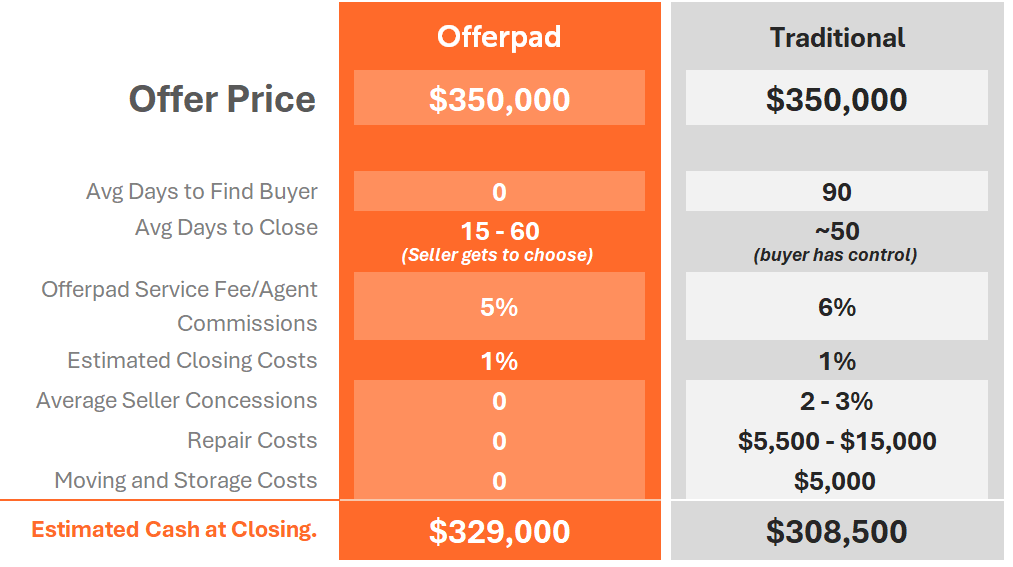
This chart compares fees and selling costs only. Actual offer prices, sale prices, and net proceeds will vary based on your home, market conditions, and selling method. A traditional listing may sell for a different price than a direct offer.
With a traditional sale, sellers typically face more line items – agent commissions, seller concessions, repair costs, and moving expenses – that can add up. With Offerpad, the fee structure is simpler: a 5% service fee plus approximately 1% in closing costs, with no concessions, no repair bills, and a free local move included.
What about Offerpad’s fees?
One of the most common questions we hear is about Offerpad’s fees and how they compare to a traditional sale. Offerpad charges a simple service fee of 5%, which replaces traditional agent commissions and covers a streamlined selling experience.
When you sell directly to Offerpad, that service fee covers benefits you won’t get through a traditional listing:
- No showings or open houses – skip the disruption of keeping your home show-ready
- Choose your closing date – close in as few as 15 days or up to 60 days, on your schedule
- No last-minute surprises – once we agree on terms, the deal is set
- No seller concessions – you won’t be asked to credit the buyer 2-3% at the closing table
- No repair costs out of pocket – if inspections reveal needed repairs, the most popular option is a simple credit adjustment with no out-of-pocket expense for you. You can also choose to make repairs yourself with licensed contractors.
- Free local move – Offerpad covers your local move (up to 50 miles) at no charge
For many sellers, the convenience and certainty of selling to Offerpad – knowing your closing date, skipping months of showings, and avoiding unexpected costs – is worth the tradeoff. Every situation is different, which is why we encourage sellers to compare their options before deciding.
Compare your options with Offerpad
Want to see what selling your home could look like? Request a free, no-obligation offer from Offerpad. You’ll see your selling options – cash offer, listing, or a combination – along with estimated timelines and costs so you can compare and choose what works best for you.
The bottom line
Selling a home costs money no matter which path you choose. A traditional listing involves agent commissions, closing costs, seller concessions, repairs, and carrying costs while your home sits on the market. Selling directly to Offerpad simplifies the fee structure – a 5% service fee plus closing costs – and eliminates many of the unpredictable expenses that come with a traditional sale.
The right choice depends on your priorities. If speed, certainty, and simplicity matter most, request a no-obligation offer from Offerpad to see how it compares to your other options.