By Otto Acosta, Offerpad Research Team
A homeowner who sold a single-family home in the St. Louis metro in 2025 sold into a market where the typical home changed hands for about $289,000 for the year, up from roughly $268,000 in 2024. That is close to $20,000 of added value on the same kind of house over twelve months.
A homeowner in the Dallas metro traveled the opposite road. There the typical single-family home sold for about $413,000 in 2025, down roughly $12,700 from 2024.
Same calendar year. Same 30-year mortgage market. Same national headlines about a cooling housing market. Two opposite outcomes for two homeowners separated only by geography.
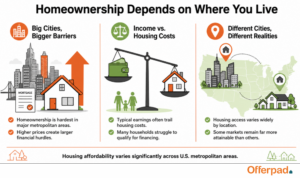
The 2025 housing market did not have a single story. It had at least fifteen.
The national headline numbers were quiet. The Federal Housing Finance Agency’s House Price Index (https://www.fhfa.gov/data/hpi) showed some of the slowest annual home-price growth since the housing recovery began. The S&P CoreLogic Case-Shiller U.S. National Home Price Index (https://fred.stlouisfed.org/series/CSUSHPISA) finished the year close to where it started. But those national readings blend rising and falling markets into a single line, and that line hides a lot.
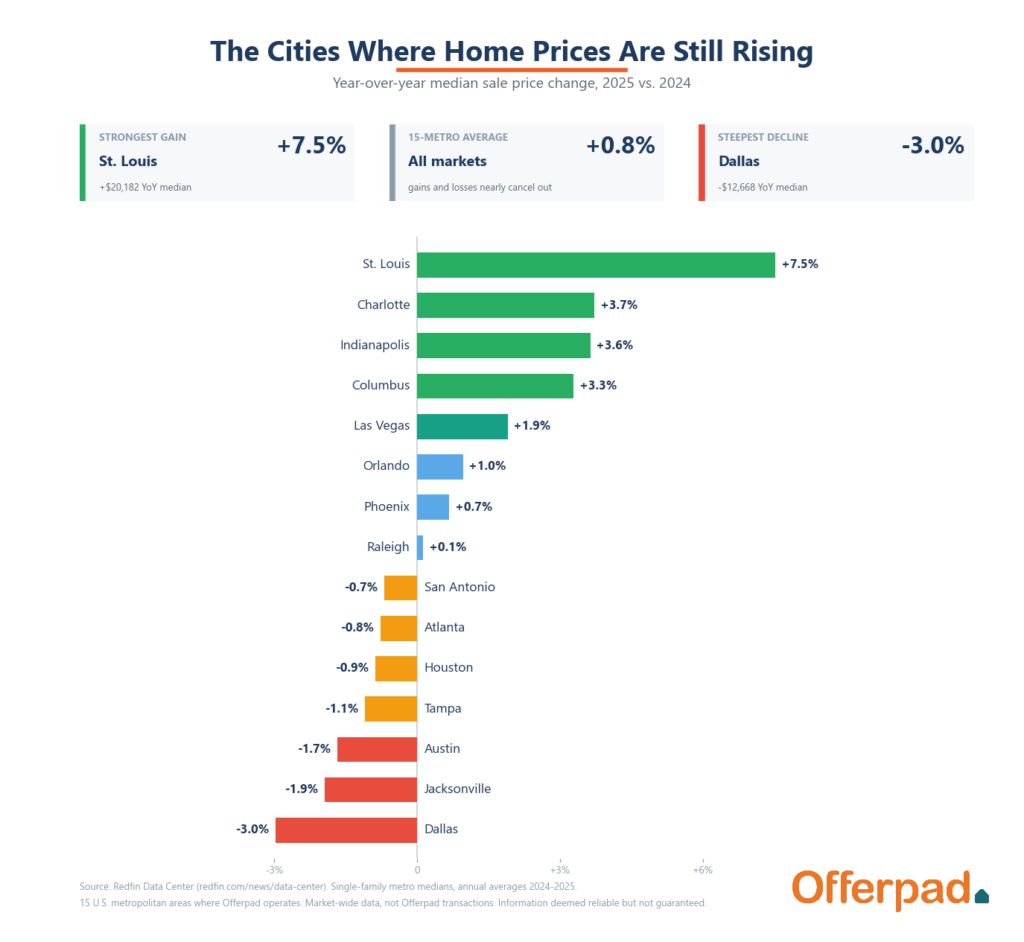
For this look at where prices held up, Offerpad reviewed market-wide metro data from the Redfin Data Center covering single-family homes across 15 U.S. metros where we operate. Five of those markets posted year-over-year (YoY) median sale price gains of 1.5 percent or more in 2025. Seven posted declines. Three came in essentially flat. The widest gap ran from St. Louis at the top to Dallas at the bottom, a spread of about 10.5 percentage points. Underneath the flat national surface, the country was sorting itself into resilient markets and correcting markets.
Where Are Home Prices Rising the Most in 2025?
The metros in this study with the largest year-over-year median sale price growth in 2025, ranked from biggest gain to smallest:
- St. Louis rose +7.5 percent ($268,372 to $288,554).
- Charlotte rose +3.7 percent ($415,498 to $430,979).
- Indianapolis rose +3.6 percent ($307,914 to $319,120).
- Columbus, OH rose +3.3 percent ($350,697 to $362,218).
- Las Vegas rose +1.9 percent ($476,858 to $485,935).
Three more metros edged higher but stayed under 1.5 percent for the year: Orlando (+1.0 percent), Phoenix (+0.7 percent), and Raleigh (+0.1 percent). Three of the five leading gainers, St. Louis, Indianapolis, and Columbus, began 2024 with median sale prices below $400,000, which kept monthly payments within reach for buyers financing at today’s higher mortgage rates. Building-permit data from the U.S. Census Bureau Building Permits Survey (https://www.census.gov/construction/bps/) shows new single-family construction in the Midwestern markets has historically run below the national pace, which keeps inventory tight relative to demand.
Full 15-Market Ranking: Year-Over-Year Median Sale Price (2025 vs. 2024)
The table below ranks all 15 metros in this study by their 2025 versus 2024 change.
| Rank | Market | 2024 Median | 2025 Median | YoY Change ($) | YoY Change (%) |
|---|---|---|---|---|---|
| 1 | St. Louis | $268,372 | $288,554 | +$20,182 | +7.5% |
| 2 | Charlotte | $415,498 | $430,979 | +$15,481 | +3.7% |
| 3 | Indianapolis | $307,914 | $319,120 | +$11,206 | +3.6% |
| 4 | Columbus | $350,697 | $362,218 | +$11,521 | +3.3% |
| 5 | Las Vegas | $476,858 | $485,935 | +$9,077 | +1.9% |
| 6 | Orlando | $435,989 | $440,186 | +$4,197 | +1.0% |
| 7 | Phoenix | $478,429 | $481,664 | +$3,235 | +0.7% |
| 8 | Raleigh | $476,265 | $476,860 | +$595 | +0.1% |
| 9 | San Antonio | $308,929 | $306,788 | -$2,141 | -0.7% |
| 10 | Atlanta | $407,675 | $404,526 | -$3,149 | -0.8% |
| 11 | Houston | $340,765 | $337,789 | -$2,976 | -0.9% |
| 12 | Tampa | $397,742 | $393,360 | -$4,382 | -1.1% |
| 13 | Austin | $448,911 | $441,398 | -$7,513 | -1.7% |
| 14 | Jacksonville | $398,769 | $391,038 | -$7,731 | -1.9% |
| 15 | Dallas | $425,382 | $412,714 | -$12,668 | -3.0% |
Source: Redfin Data Center, single-family metro medians, 2024 and 2025. Annual figures are the average of Redfin’s reported monthly metro medians for each year.
Averaged across all fifteen metros, the year’s gains and losses came close to canceling out, which is why the national indexes read as flat. But that quiet average sits on top of a roughly 10.5-percentage-point gap between the strongest market (St. Louis) and the weakest (Dallas). The national number is real. It just does not describe any one place.
The Quiet Comeback of the Affordable City
The story of 2025’s resilient housing markets is the story of cities that never went viral.
St. Louis. Indianapolis. Columbus. Charlotte. None drew floods of remote workers from California or New York during the pandemic. None topped most-searched lists on national real estate websites. They did not produce the eye-catching double-digit price gains of 2020 to 2022 that made Austin and Tampa household names.
Now they are the markets where prices kept rising.
St. Louis led the study at 7.5 percent annual median price growth, the biggest gain among the 15 metros and 3.8 percentage points ahead of the next-closest market. For a typical seller, that worked out to close to $20,000 of added value on the same property over the year.
The pattern in St. Louis is what an appraiser would call boring, and that is the point. The city’s homes were already priced low enough that higher mortgage rates did not break buyer affordability. New construction lagged behind population growth. Local employment grew at a modest but steady pace. None of the conditions for a price spike were present, but neither were the conditions for a drop. What St. Louis offered was a floor under prices.
Charlotte and Indianapolis followed at 3.7 and 3.6 percent. Columbus, Ohio, gained 3.3 percent, helped by a growing logistics and advanced-manufacturing base in central Ohio. Charlotte’s rise continues a Carolinas migration trend that has now lasted long enough to look permanent rather than seasonal.
Las Vegas rounded out the group of clear gainers at 1.9 percent. Las Vegas is the surprise on that list. The market had cooled visibly through 2023 and early 2024, so a return to steady appreciation points to local demand finding its feet again.
Phoenix at the Hinge
Phoenix is one of the more informative markets to watch in 2026, in part because it sits so close to the breakeven line.
Median sale prices grew 0.7 percent year over year, one of the smallest gains in the study. The Phoenix story since 2022 has been a test of whether pandemic-era price gains would hold or unwind. As of 2025, the answer is neither. They are sticking, but not adding.
Phoenix is also one of a few markets where the headline median and the median price per square foot point in different directions. Median sale prices rose 0.7 percent. Median price per square foot fell 0.8 percent. That gap suggests larger homes made up a slightly bigger share of 2025 closings than in 2024, which is a mix-of-homes effect rather than underlying appreciation. On a price-per-square-foot basis, Phoenix reads as flat to slightly down, not flat to slightly up.
Where Are Home Prices Falling?
Seven markets posted year-over-year median sale price declines in 2025. They cluster into three groups.
The Texas correction. Dallas (-3.0 percent) posted the steepest decline in the study, followed by Austin (-1.7 percent), Houston (-0.9 percent), and San Antonio (-0.7 percent). All four major Texas metros gave back ground. Pandemic-era buyers paid prices that assumed continued tech-sector hiring, continued migration from California, and continued inventory shortages. By 2025, all three of those drivers had eased. Hiring slowed. Net migration cooled. Builders, especially around Austin and Dallas, delivered projects that had been in the pipeline for years.
Florida, going two ways. Jacksonville fell 1.9 percent and Tampa fell 1.1 percent, while Orlando edged up 1.0 percent. Florida property insurance costs rose sharply between 2022 and 2024, according to the Insurance Information Institute (https://www.iii.org/article/insurance-fact-book). When insurance climbs, the buyer’s monthly housing cost rises regardless of the asking price, and buyers respond by bidding less for the home itself. That pressure shows up in Jacksonville and Tampa. Orlando shows it is not the whole story.
Atlanta in the middle. Atlanta’s 0.8 percent decline is one of the smallest negative changes in the study. The metro sits at the boundary between the Texas correction and the Carolinas appreciation, and its result reflects both pulls at once.
Three-Year View: Cumulative Home Price Change 2023 to 2025
A single-year reading can hide longer trends. The table below shows the annual median sale price for each market in 2023, 2024, and 2025, along with the cumulative change over the stretch.
| Rank | Market | 2023 Median | 2024 Median | 2025 Median | 3-Year Change |
|---|---|---|---|---|---|
| 1 | St. Louis | $253,648 | $268,372 | $288,554 | +13.8% |
| 2 | Las Vegas | $443,891 | $476,858 | $485,935 | +9.5% |
| 3 | Columbus | $333,347 | $350,697 | $362,218 | +8.7% |
| 4 | Indianapolis | $295,173 | $307,914 | $319,120 | +8.1% |
| 5 | Charlotte | $402,162 | $415,498 | $430,979 | +7.2% |
| 6 | Phoenix | $460,170 | $478,429 | $481,664 | +4.7% |
| 7 | Raleigh | $459,310 | $476,265 | $476,860 | +3.8% |
| 8 | Orlando | $425,538 | $435,989 | $440,186 | +3.4% |
| 9 | Atlanta | $394,167 | $407,675 | $404,526 | +2.6% |
| 10 | Jacksonville | $386,208 | $398,769 | $391,038 | +1.3% |
| 11 | Tampa | $390,706 | $397,742 | $393,360 | +0.7% |
| 12 | Houston | $336,202 | $340,765 | $337,789 | +0.5% |
| 13 | San Antonio | $313,700 | $308,929 | $306,788 | -2.2% |
| 14 | Dallas | $424,392 | $425,382 | $412,714 | -2.8% |
| 15 | Austin | $459,014 | $448,911 | $441,398 | -3.8% |
Source: Redfin Data Center, single-family metro medians, 2023 to 2025.
St. Louis leads the three-year board at 13.8 percent cumulative growth, the only market in this study to clear ten percent over the stretch. Las Vegas takes second at 9.5 percent. Columbus, Indianapolis, and Charlotte round out the top five.
The bottom of the table tells the harder story. Three markets ended 2025 below their 2023 starting points, and all three are in Texas: Austin (-3.8 percent), Dallas (-2.8 percent), and San Antonio (-2.2 percent). Houston and Tampa essentially round-tripped, landing within a percentage point of where they began. These are not collapses. They are steady pressure on the sellers who bought in 2021 and 2022 expecting their homes to keep gaining value.
The most recent monthly reading extends the pattern. By May 2026, the single latest month in the data, St. Louis’s median stood at $318,750 and Las Vegas’s at $495,990, both above their 2025 annual figures, while the Texas metros that lagged over three years had begun to firm up.
For the country as a whole, three years of housing-market churn produced almost no net change across the fifteen metros. For an individual seller in St. Louis, those three years added close to $34,900 to the local median. For a seller in Austin, the same three years took back about $17,600.
Into 2026: Is the Trend Continuing?
The freshest read on whether the 2025 patterns held is the year-over-year change in the latest month of data, May 2026 compared with May 2025. That is a like-for-like, same-month comparison, which avoids the seasonal noise in any single quarter. The table also shows the first-quarter 2026 average median for context. First quarter is the seasonally slowest stretch of the year, so those figures sit below each market’s spring level by design.
| Market | Q1 2026 Avg Median | May 2026 Median | May 2026 YoY (%) |
|---|---|---|---|
| St. Louis | $279,258 | $318,750 | +6.8% |
| Jacksonville | $384,745 | $419,900 | +6.3% |
| Dallas | $402,167 | $430,000 | +3.4% |
| Columbus | $360,167 | $385,000 | +2.7% |
| Indianapolis | $309,916 | $333,820 | +2.7% |
| Las Vegas | $481,388 | $495,990 | +2.3% |
| Houston | $331,648 | $349,900 | +2.2% |
| Charlotte | $420,833 | $445,000 | +1.8% |
| Tampa | $390,000 | $405,000 | +1.3% |
| Atlanta | $395,000 | $420,000 | +1.2% |
| San Antonio | $303,182 | $315,000 | +1.0% |
| Austin | $420,495 | $459,000 | +0.9% |
| Phoenix | $482,980 | $485,000 | 0.0% |
| Raleigh | $460,667 | $485,000 | -0.2% |
| Orlando | $436,667 | $445,000 | -1.1% |
Source: Redfin Data Center, single-family metro data. Q1 2026 is the average of the January through March 2026 monthly medians. May 2026 YoY is Redfin’s May 2026 median compared with May 2025.
Most of the 2025 storylines hold into the new year, and a couple shift. St. Louis stayed the strongest market, up 6.8 percent year over year in May 2026. The bigger surprises are at the metros that had struggled. Jacksonville swung from a 1.9 percent full-year 2025 decline to a 6.3 percent same-month gain by May 2026, an early sign that Florida is not moving as one market. Dallas, the weakest metro of 2025, had recovered to a 3.4 percent year-over-year gain by May 2026.
A few markets moved the other way. Orlando slipped to a 1.1 percent decline in the latest month after a positive 2025, and Raleigh and Phoenix sat right at the flat line. The early-2026 signal is that most of these metros are firmer than the calendar-year 2025 numbers alone would suggest, but the direction is not uniform.
Median Sale Price vs. Price Per Square Foot: A Sanity Check
Median sale price can move because the mix of homes sold changes (more luxury closings versus more starter-home closings) as much as because home values themselves changed. Median price per square foot strips out part of that mix effect.
For 12 of the 15 markets in this study, the year-over-year direction of median sale price and median price per square foot agree, which supports the headline rankings. The three exceptions are Orlando (median sale price up 1.0 percent, price per square foot down 0.9 percent), Phoenix (up 0.7 percent, down 0.8 percent), and Raleigh (up 0.1 percent, down 0.5 percent). All three are best read as essentially flat on an underlying-value basis.
St. Louis leads on both measures (+7.5 percent on median sale price, +3.2 percent on median price per square foot). Dallas trails on both (-3.0 percent on median sale price, -4.0 percent on price per square foot). Where the two measures agree, the headline ranking is reliable. Where they split, the price-per-square-foot reading is the more conservative one.
Why the National Headline Misses the Picture
The S&P CoreLogic Case-Shiller National Home Price Index and the FHFA House Price Index both showed 2025 as one of the slowest years for home-price growth since the housing recovery began. But “flat” at the national level can mean very different things on the ground.
It can mean a market like St. Louis, where prices grew steadily and the typical seller in 2025 saw a local gain of close to $20,000.
It can mean a market like Dallas, where the median fell and the typical seller saw local erosion of roughly $12,700.
It can mean a market like Phoenix, where the headline barely moved at all.
For 2025, the national average is an unusually poor stand-in for what individual sellers actually experienced.
What the Numbers Show for the 2026 Housing Market
The data points to a clear split in the U.S. housing market.
Affordable Midwestern and inland Southern markets keep absorbing buyer demand. St. Louis, Indianapolis, Columbus, and Charlotte all share lower price floors that have held up through the higher-rate environment. The 7.5 percent gain in St. Louis is the standout result of 2025.
Pandemic boomtowns keep giving back gains. Austin, Dallas, and San Antonio all ended 2025 below their 2023 levels, and Houston essentially round-tripped. The correction is uneven but persistent.
Florida is not a single story. Tampa and Jacksonville declined in 2025, while Orlando edged higher, and by May 2026 Jacksonville had swung to one of the strongest year-over-year gains in the group. Insurance-cost pressure affects all three metros, but it does not produce identical outcomes.
For homeowners weighing whether their property gained or lost value last year, the question is not what the national index did. It is which of the fifteen local stories applies to their own city. Your best move is to compare your options and look at what homes like yours are actually selling for nearby before you decide anything.
Methodology
This analysis uses market-wide metro data from the Redfin Data Center (https://www.redfin.com/news/data-center/) for single-family homes, as of May 2026. It covers 15 major U.S. metropolitan areas where Offerpad operates: Atlanta, Austin, Charlotte, Columbus (OH), Dallas, Houston, Indianapolis, Jacksonville, Las Vegas, Orlando, Phoenix, Raleigh, St. Louis, San Antonio, and Tampa. Columbia, South Carolina, is not included because Redfin does not publish comparable metro-level data for it.
All figures are market-wide Redfin metro data, not Offerpad transactions. Annual figures for 2023, 2024, and 2025 are the average of Redfin’s reported monthly metro medians for each calendar year, and year-over-year comparisons use those annual figures. The May 2026 year-over-year change is Redfin’s median for May 2026 compared with May 2025, a same-month comparison. First-quarter 2026 figures are the average of the January through March 2026 monthly medians.
Median price per square foot is used as a cross-check on whether headline median changes reflect underlying value or a shift in the mix of homes sold. For 12 of the 15 markets, the two measures agree in direction. Orlando, Phoenix, and Raleigh are the exceptions and are noted in the analysis above.
Supporting national context is drawn from the S&P CoreLogic Case-Shiller U.S. National Home Price Index (via FRED), the Federal Housing Finance Agency House Price Index, and the U.S. Census Bureau Building Permits Survey, all linked inline above. Florida insurance-cost context is from the Insurance Information Institute. Information is deemed reliable but not guaranteed.